

In the software development ecosystem, when we talk about agile methodologies, Scrum and Kanban tend to be the undisputed protagonists, often leaving Extreme Programming (XP) as “the forgotten one.”
However, for roles like Manager / Scrum Master / Flow Master who aim not only to organize work but to ensure technical excellence and team sustainability, overlooking XP is a strategic mistake. While other frameworks focus on management flow, XP focuses on the trenches—on how the product is built to be robust, flexible, and sustainable.
What is XP?
If you’ve never gone deep into XP, think of it not as a radical invention, but as a collection of what actually works. Just as J.R.R. Tolkien didn’t invent myths about elves and dwarves, but instead compiled and systematized centuries of European folklore into a coherent and functional mythology, Kent Beck did something similar with software engineering in the late ’90s.
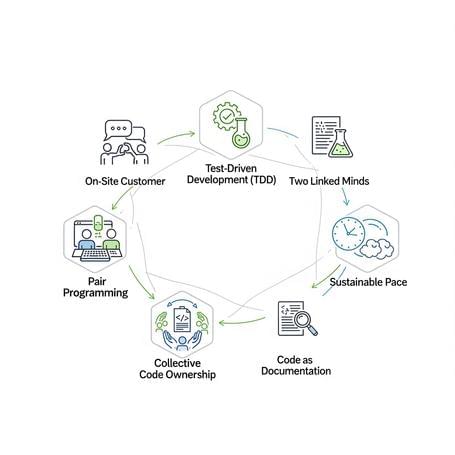
Beck didn’t invent testing, code review, or customer collaboration. What XP did was gather these isolated “best practices”, already known to improve quality, and push them to the extreme of their effectiveness, organizing them under a unified philosophy.
Beyond technical excellence, XP also emphasized the importance of having what we now call a Product Owner physically present with the team (on-site customer) to improve the conversation between business and development. Additionally, one of XP’s most remembered contributions to Agile is User Stories as we know them today (with the 3 C’s), replacing heavy and hard-to-understand requirement documents.
In short, XP is a framework designed to reduce risk in projects with vague or changing requirements, applying strong technical practices, fostering communication, and discarding what is not needed at the moment. In summary: prioritizing customer satisfaction and software quality.
That’s the quick overview for those who missed that class.
But be careful: thinking XP is just this (a set of programming practices) is like reading the synopsis “a dysfunctional family in space” and assuming you understand the entire Star Wars saga.
What that summary misses is the real value for leadership. XP is a system for risk management and psychological safety.
XP assumes that agility without technical excellence becomes a factory of technical debt. That’s why it builds an unbreakable safety net (through automated testing, continuous integration, and simple design) that allows teams to move fast, adapt constantly, and avoid burnout. It ensures that speed doesn’t destroy quality.
And it is precisely this tension between speed and safety that hits us today.
We now have in our hands the greatest productivity accelerator in history: Generative AI. But generating code at high speed is not the same as generating maintainable or correct code. How do we govern this new hyper-speed without burning out teams or breaking products? The answer has existed for nearly 30 years.
A new hope: evolving XP with Artificial Intelligence
How does this ’90s framework fit into the era of Generative AI? The reality is that AI doesn’t make XP obsolete—on the contrary, it turns it into the necessary safety structure for this new speed. We are witnessing the birth of AI-XP (term used by Justin Beall).
Integrating AI into XP is not just about using autocomplete tools—it’s a systemic evolution that enhances the framework’s original principles through three modern feedback loops:
- VISION (Planning). Where we once relied only on human intuition to define long-term goals, AI can now analyze market data to align XP’s “Planning Game” with real needs and trend predictions.
- ADAPT (Agile iterations). AI acts as a facilitator that improves responsiveness. It can help break down complex user stories and ensure the team understands acceptance criteria, reducing ambiguity.
- LEAP (Daily execution). This is where classic Pair Programming evolves into “AI Pairing.” AI handles routine and boilerplate code, allowing developers (the “navigator”) to focus on strategy, security, and design.
The new paradoxes of AI-XP
Before celebrating and assuming AI plus ’90s practices will solve everything, as technical and delivery leaders we must reflect. This new model introduces paradoxes and uncertainties that will reshape the rules:
- The user story paradox
Originally, XP freed us from heavy requirement documents with lightweight user stories (promises of conversation). Today, to prevent AI from hallucinating, we need extremely rich context (detailed specs, exhaustive prompts, explicit business rules).
Are we returning to hyper-documentation just so machines understand us? The challenge is ensuring AI requirements don’t kill human conversation.
- Redefining the “hybrid team”
Not long ago, hybrid meant remote vs. in-office. Today, a modern hybrid team is composed of human minds and AI agents. Managing trust, expectations, and collaboration in this new setup is the real challenge for Agile Coaches.
- AI as the new “knowledge silo”
XP promoted Collective Code Ownership to avoid knowledge concentration. But what happens if AI writes most of the code and developers only review it? We risk turning AI into a black box, losing deep understanding and control of our product.
Back to humanity
In conclusion, AI has the potential to accelerate software delivery—but also to accelerate chaos without proper governance, and XP provides that governance.
By automating technical complexity and routine code generation, AI enables XP to fulfill its most ambitious promise: humanity and respect.
Freed from repetitive coding tasks, teams can focus on what XP has always valued most: creativity, complex problem-solving, and high-value human collaboration. XP is not dead—it has simply found, thirty years later, the perfect tool to reach its full potential.

David García Luna
I started as a developer, learned the ins and outs of SEO, and stayed in the agile world for one reason: I like things to work—but above all, I care about people doing well. My mission is to create environments of trust where metrics speak for themselves and obstacles disappear. I’m the bridge that translates technical needs into business value without losing anything along the way. An aviation and data enthusiast, I’m always ready for a new destination whether it’s a complex project, a long trip, or a great conversation over a few beers.
View more of David.More thoughts about this.
Read more.
Real transformation or fake transformation?

The offices of the Future.
When democracy is not the best solution.
Building Paradigma’s DNA.
Comments are moderated and will only be visible if they add to the discussion in a constructive way. If you disagree with a point, please, be polite.

Tell us what you think.