

A few weeks ago, at the Smart Energy Congress 2025 by Enertic, I posed a challenge to the audience. A challenge I want to share here today:
Imagine that tomorrow you are given carte blanche to redesign your technology platform. You have complete freedom, but with one single condition: every decision must comply with and be aligned with ESG criteria (Environmental, Social, and Governance).
The question is: would you still do things the same way you do today?
This question is far from trivial. For years, technology has been seen as an enabler of business strategy and sustainability—a complement to corporate strategy. But this paradigm is outdated. In the energy sector, and in any other industry, ESG criteria are no longer a complement; they must be part of the very core of a company’s strategy.
And technology is not just an enabler: ESG principles determine the capabilities of technology platforms, enabling us to address the challenges of the energy sector and deploy new business models.
The virtuous circle: from ESG principles to the business model
The relationship between ESG and technology is a virtuous pairing that turns challenges into opportunities.
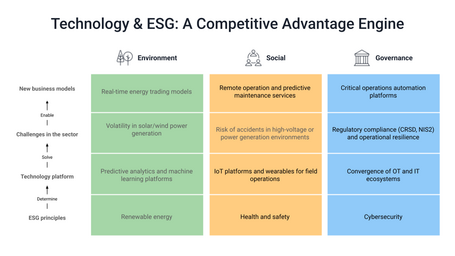
- ESG principles: let’s start with the principles. A commitment to integrating renewable energy (E), improving employee health and safety (S), or ensuring our infrastructures are cybersecure (G) are not just statements of intent.
- They define the technology platform: these principles actually define the technological capabilities we need. A commitment to renewables requires predictive analytics platforms to manage intermittency in generation infrastructures; employee safety in transport infrastructure maintenance drives the adoption of IoT and wearables in the field; and cybersecurity demands the convergence of OT and IT ecosystems.
- They solve sector challenges: the deployed technological capabilities help us solve the major challenges in the sector—volatility in solar or wind generation, accident risk in high-voltage environments, or compliance with complex regulations such as NIS2 or CSRD.
- They enable competitive advantage: by designing the technology platform guided by ESG principles, we solve sector challenges and enable new business models—real-time energy trading models, remote operations and predictive maintenance services, or the automation of critical operations.
As we can see, integrating ESG from the design phase is not a cost; it is a foundational pillar that helps us become truly competitive and transform our business.
8 key decisions to integrate ESG into your platform
How do we move from theory to practice? Where do we apply this vision?
Each company has a different business model depending on the sector it operates in. As a result, the technology used to support the business adapts to each specific need, and so do the types of teams required around it (Infrastructure and Enterprise Architecture, Cybersecurity, Workplace, Applications, Data & Analytics, AI…).
That’s why, a few months ago, I asked myself the same question I posed to speakers and attendees. I imagined that, in a few years, I might be fortunate enough to launch my own startup—one where I would want the technology platform to truly reflect my potential business model and integrate ESG across the entire value chain.
Based on this scenario, I believe there are 8 key technology decision points where we can (and must) integrate ESG criteria. This is the “ESG technology decision map”:
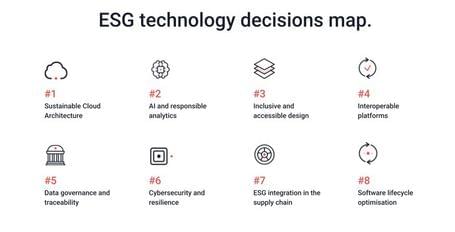
- Sustainable Cloud Architecture
- AI and responsible analytics
- Inclusive and accessible design
- Interoperable platforms
- Data governance and traceability
- Cybersecurity and resilience
- ESG integration in the supply chain
- Software lifecycle optimisation
These eight points form the roadmap for building purpose-driven platforms. It’s not just about reducing energy consumption—it’s about being more efficient, more fair, more secure, and ultimately more competitive.
In the upcoming articles of this series, we’ll dive deeper into each of these areas, detailing the key factors in technology selection and usage, the real impact they have on ESG strategy, and the tangible benefits your organization can achieve.

Nacho Badenes
I am the Director of Technology Strategy for the Utilities & Energy market at Paradigma Digital. A specialist in Data, Analytics & AI, I work alongside leading companies in the sector to design cloud architectures and digital platforms that drive innovation and operational optimization. My strategic, business-oriented mindset connects enterprise challenges with intelligent and sustainable technology solutions, helping build a more efficient, resilient, and data-driven future.
View more of Nacho.More thoughts about this.
Read more.
Business Driven: The Pending Revolution in IT.

Product results in ChatGPT: the impact of ChatGPT Shopping.

What is TOGAF and why is it useful?

Improving test quality with mutation testing.

Comments are moderated and will only be visible if they add to the discussion in a constructive way. If you disagree with a point, please, be polite.

Tell us what you think.