

In the previous post, we explored in depth how decisions around cloud, AI, inclusive design, and interoperability lay the foundations for a purpose-driven architecture. However, for a platform to truly have purpose and align with ESG principles, it’s not enough to focus on how it is built; it must also be managed and protected with the same level of awareness.
Today, we complete our map of 8 key technology decisions by analyzing the final four pillars that ensure the integrity, security, and long-term impact of our digital ecosystem.
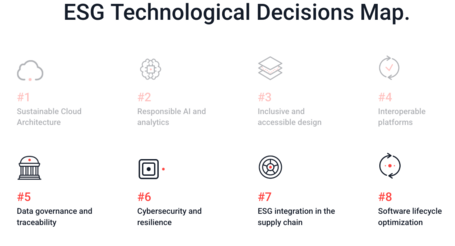
5 Data governance and traceability
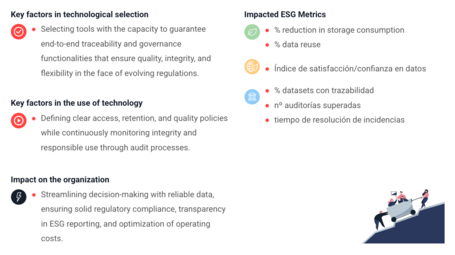
This is the engine that ensures data remains a trustworthy asset, directly impacting the company’s Governance (G). Reliable data doesn’t just ensure compliance—it accelerates decision-making and builds market trust.
Key selection factors
Data must have a clear identity and ownership. It is essential to choose technologies that guarantee end-to-end traceability for critical data and provide governance capabilities that ensure quality and integrity.
- Key usage factors
Transparency is non-negotiable. It requires clearly defined access and retention policies, along with continuous security monitoring and audit processes for responsible usage.
- Organizational impact
Faster decisions driven by trusted data. The result is strong regulatory compliance and support for ESG transparency through verifiable and auditable reporting.
“Trusted data doesn’t just ensure compliance: it accelerates decisions, builds market confidence, and opens the door to new opportunities.”
6 Cybersecurity and resilience
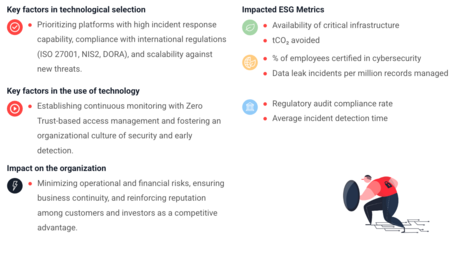
Security is not a cost; it is the insurance policy that protects business continuity and value, making it a critical pillar of Governance (G) and Social Responsibility (S).
- Key selection factors
Prepare for “when,” not “if.” We must evaluate incident response and recovery capabilities, ensuring compliance with standards such as ISO 27001, NIS2, or DORA.
- Key usage factors
No one enters without permission. Implement Zero Trust-based access management and foster a security culture through continuous training and strict protocols.
- Organizational impact
Peace of mind knowing your business is resilient. It minimizes financial risks from cyberattacks, ensures operational continuity, and strengthens trust among customers and investors.
“Security is no longer a cost: it is the insurance policy that protects continuity, reputation, and business value.”
7 ESG integration in the supply chain
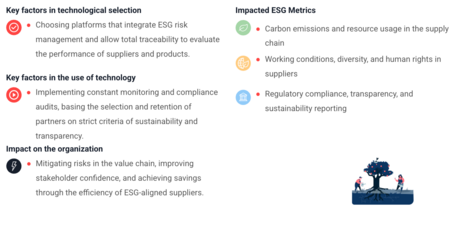
Our technological responsibility extends to every partner; a supply chain aligned with Environmental (E), Social (S), and Governance (G) criteria is more competitive and reliable.
- Key selection factors
Tell me who you work with, and I’ll tell you who you are. It is essential to adopt platforms that enable supplier traceability and integrate with ESG risk management systems.
- Key usage factors
Your suppliers’ commitment is your own commitment. It requires continuous monitoring of their ESG performance and clear criteria for selection and retention.
- Organizational impact
A “clean” platform end to end. It reduces reputational risks across the value chain and ensures compliance with governance best practices.
“An ESG-aligned supply chain is more competitive, more reliable, and more attractive to customers and investors.”
8 Software lifecycle optimization
Efficient code means lower costs and faster delivery; it contributes positively to the Environmental (E) pillar by optimizing resource consumption.
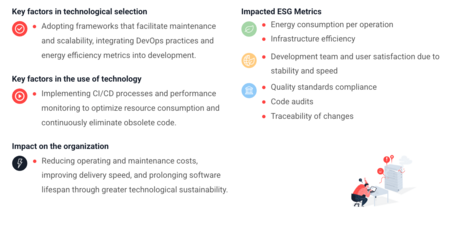
- Key selection factors
Build today with tomorrow in mind. Choose frameworks that facilitate maintainability and scalability, while supporting energy efficiency metrics.
- Key usage factors
Deploy fast, but thoughtfully. Implement CI/CD processes for agile delivery and apply refactoring strategies to eliminate obsolete code that consumes unnecessary resources.
- Organizational impact
Sustainability translated into profitability. It reduces operational costs, improves delivery quality, and extends the lifespan of technological assets.
“Efficient code means lower costs, faster delivery, and development that leaves a… positive footprint.”
Conclusion: choosing technology is choosing the future
As I shared at the Smart Energy Congress 2025, choosing technology is choosing the future. By integrating these 8 decision points into our strategy, we transform technology from a support function into a driver that aligns business with social, environmental, and governance challenges.
- Enabler of real impact: technology drives everything from energy efficiency to digital inclusion.
- Competitive advantage: conscious decisions in architecture, data, security, AI, and accessibility enable new business models.
- Investment in resilience: purpose-driven design is not a cost, but an investment that fosters innovation and trust.
- Engine of transformation: platforms don’t just support the business—they connect it to a positive global impact.
"True technological disruption lies not in what machines can do, but in the purpose we choose when designing them."
After everything shared in this series of three posts on technology platforms, what will you do from today onwards? I’ll read you in the comments.

Nacho Badenes
I am the Director of Technology Strategy for the Utilities & Energy market at Paradigma Digital. A specialist in Data, Analytics & AI, I work alongside leading companies in the sector to design cloud architectures and digital platforms that drive innovation and operational optimization. My strategic, business-oriented mindset connects enterprise challenges with intelligent and sustainable technology solutions, helping build a more efficient, resilient, and data-driven future.
View more of Nacho.More thoughts about this.
Read more.
Purpose-Driven Technology Platforms: Aligning Technology, Business, and Sustainability.

Purpose-Driven Technology Platforms: Integrating ESG Criteria from the Design Stage.

Business Driven: The Pending Revolution in IT.

Product results in ChatGPT: the impact of ChatGPT Shopping.

Comments are moderated and will only be visible if they add to the discussion in a constructive way. If you disagree with a point, please, be polite.

Tell us what you think.