

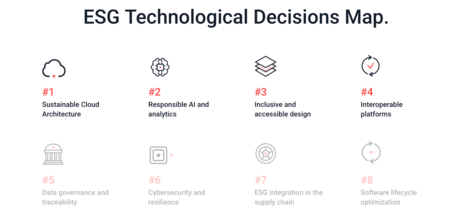
In the previous post, we introduced the concept of "Purpose-Driven Technology Platforms", showing how integrating ESG criteria from the design phase becomes a true engine of competitive advantage. We also presented the Map of 8 Key Technology Decisions to achieve it.
Today, we’re going to dive deeper into the first four points of that map, analyzing how to make conscious decisions at the very foundation of our architecture.
1 Sustainable Cloud Architecture
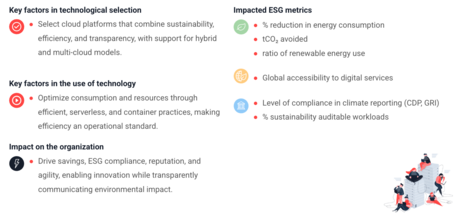
Migrating to the cloud is no longer optional, but how we migrate and which cloud we choose has a direct environmental (E) and governance (G) impact.
- Key selection factors
The decision must go beyond price. It’s essential to choose cloud providers with clear Net Zero goals and that offer full transparency in carbon footprint reporting. We also need native optimization and auto-scaling capabilities that work on our behalf.
- Key usage factors
Simply “being” in the cloud is not enough. We must apply efficient workload sizing (right-sizing), avoid compute waste by using serverless services and containers, and establish strict policies for storage efficiency and data retention.
- Impact on the organization
The outcome is twofold. On the one hand, a significant reduction in operating costs thanks to energy efficiency. On the other, leadership in sustainability that strengthens reputation with customers, employees, and investors.
“Every watt optimized in the cloud reduces costs and carbon footprint: sustainability that shows up in the bottom line.”
2 Responsible AI and analytics
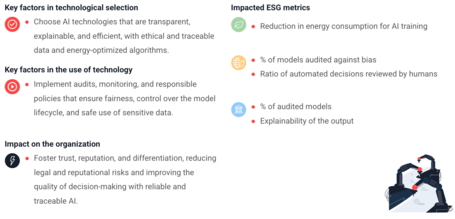
Artificial Intelligence is perhaps the most powerful tool in our arsenal, but its social (S) and governance (G) impact is enormous. “Responsible” AI is not optional.
- Key selection factors
We must prioritize platforms that provide transparency and explainability (XAI). The data that feeds them must be traceable and ethically sourced, and the algorithms themselves must be optimized for energy efficiency, both in training and inference.
- Key usage factors
AI cannot be a “black box.” It requires regular audits for bias and fairness, strict control over the model lifecycle, and clear policies around the responsible use of sensitive data.
- Impact on the organization
Responsible AI builds trust and reputation. It drastically reduces legal and reputational risks associated with bias and, most importantly, improves strategic decision-making with analytics that are both reliable and traceable.
“Responsible AI multiplies efficiency and reduces risk: technology that drives the business and strengthens trust across the board.”
3 Inclusive and Accessible Design
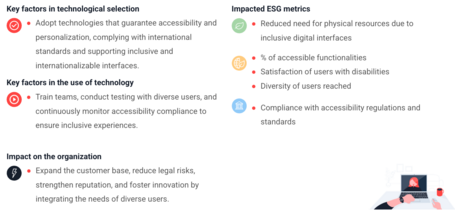
This is the heart of the Social (S) pillar. A technology platform that is not accessible to everyone simply does not fulfill its purpose.
- Key selection factors
The underlying technology must be compatible with accessibility standards (such as WCAG 2.1). Development tools should provide native accessibility support, and the interface must be flexible enough to adapt to different user needs.
- Key usage factors
Accessibility is a continuous process, not a one-time check. It requires ongoing team training, usability testing with diverse users, and iterative monitoring to fix issues as they arise.
- Impact on the organization
The benefits are tangible. We expand our customer base to segments we couldn’t reach before, reduce legal risks related to regulatory non-compliance, and strengthen corporate reputation through a visible commitment to inclusion.
“An accessible platform is not only fair: it expands the market, builds loyalty, and demonstrates the company’s real commitment.”
4 Interoperable Platforms
Data silos are the enemy of efficiency (E) and good governance (G). A modern platform must be designed to collaborate.
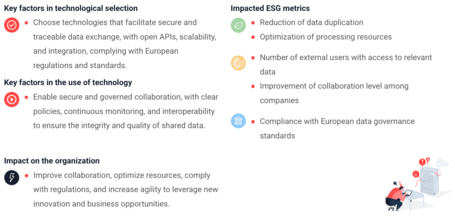
- Key selection factors
We look for platforms based on open standards and APIs for secure data exchange. It’s vital that they comply with European regulations and data space standards, and that they offer native traceability and auditing capabilities.
- Key usage factors
The goal is to enable shared data spaces and secure collaboration between organizations. This requires clear access policies and data flow monitoring to ensure integrity.
- Impact on the organization
Interoperability reduces redundancy and optimizes technology resources. It strengthens data governance and provides greater agility to seize new business and innovation opportunities.
“Interoperability opens doors: to new business, greater agility, and technology that grows with the company.”
Conclusions
With this, we’ve laid the foundations: an efficient cloud, ethical AI, design for everyone, and systems that talk to each other.
In the next and final post of this series, we’ll close the circle with the remaining four points—from data governance flowing through these platforms to the cybersecurity that protects them. Looking forward to your thoughts in the comments 👇.

Nacho Badenes
I am the Director of Technology Strategy for the Utilities & Energy market at Paradigma Digital. A specialist in Data, Analytics & AI, I work alongside leading companies in the sector to design cloud architectures and digital platforms that drive innovation and operational optimization. My strategic, business-oriented mindset connects enterprise challenges with intelligent and sustainable technology solutions, helping build a more efficient, resilient, and data-driven future.
View more of Nacho.More thoughts about this.
Read more.
Purpose-Driven Technology Platforms: Integrating ESG Criteria from the Design Stage.

Business Driven: The Pending Revolution in IT.

Product results in ChatGPT: the impact of ChatGPT Shopping.

What is TOGAF and why is it useful?

Comments are moderated and will only be visible if they add to the discussion in a constructive way. If you disagree with a point, please, be polite.

Tell us what you think.