

This year I didn’t have the chance to publish my prediction on 2026 trends, so I’d like to take this opportunity to share a series of three posts about what I see as a key trend in Artificial Intelligence, of course.
From Cognitive Load to Model Load
If you’ve been following what we’ve published at Paradigma, you already know our mantra and our Platform Engineering series: the discipline was born to free development teams from operational hell.
Do you remember that “sentence” of You Build It, You Run It? It created an unbearable cognitive load. Countless teams, instead of inventing the next feature that brings business value, spent their days fighting with Kubernetes, Prometheus, and a thousand other tools.
The truth is, Platform Engineering has been our great lever to bring order to that chaos and tell development teams: “Focus on the secret sauce, we’ll take care of the kitchen.”
The pattern is always the same when a technological shift or new trend emerges: we start experimenting, applying it to use cases, and then we feel the need to scale and bring it to production as quickly as possible.
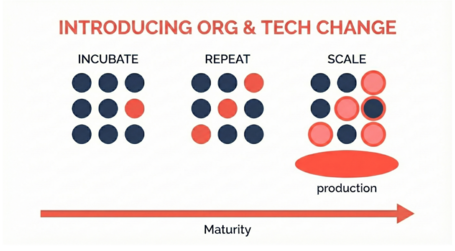
But you know what? Just when we begin to breathe again, the next big wave arrives and it’s… even more complex.
In this case, I’m talking (as you might expect) about Artificial Intelligence and Machine Learning. This isn’t just about code and infrastructure; it’s about data, expiring models, versioning, explainability, and an MLOps lifecycle that is frankly a superset of what we already had in DevOps.
That’s why my bet is clear: 2026 will not simply continue the “AI everywhere” narrative, 2026 will be the year when the AI Platform becomes a strategic imperative for both business and technology inside companies, not an option.
The Platform Engineering legacy: friction reduction as the foundation for MLOps
Platform Engineering is our recipe for success: the use of Golden Paths to standardize, and the Internal Developer Platform (IDP) as a self-service entry point so no one has to open a ticket just to spin up an environment.
Now we add ML to the equation. And the problem is that a data scientist cannot be configuring CI/CD pipelines for a model or dealing with networking. They simply can’t (and even if they could, they shouldn’t).
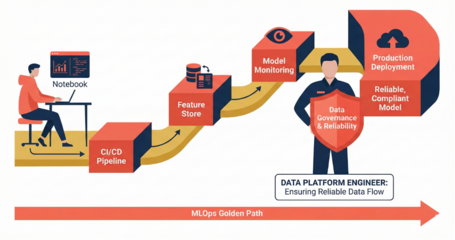
MLOps needs the same Golden Paths we built for traditional software but extended to more delicate tasks. Imagine a Golden Path that guides you from the experimental notebook where you play with algorithms and models, all the way to production deployment with traceability, feature stores, and model monitoring… all in one go!
And here we see the first major specialization emerging. In the coming years, I believe we’ll see a surge in the Data Platform Engineer role. This role doesn’t just manage the IDP; it focuses on ensuring the reliability and governance of the data that feeds the model.
If the model is a black box, at least let’s make sure the data inputs feeding it are flawless! This is not a minor technical detail it’s a matter of corporate trust and compliance.
Fundamental distinction: Platforms with AI vs. Platforms for AI
At the CxO level, we must be precise with terminology. Because using AI to improve your platform is not the same as building a platform to do AI. The difference determines where you should place the bulk of your AI budget.
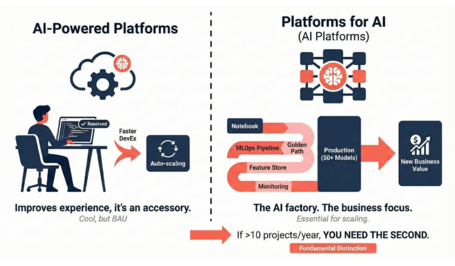
- Platforms with AI (AI-powered platforms). This is cool, trendy (and like all trends, it will eventually become BAU). It’s about using AI inside the platform to enhance developer experience. Think automated troubleshooting or predictive auto-scaling. Great, but it’s an add-on that improves DevEx.
- Platforms for AI (AI Platforms). This is the real focus. This means building infrastructure, tools, and Golden Paths specifically to support the entire MLOps lifecycle end-to-end. It’s the factory that allows you to move from three models in production to fifty. It’s the layer that generates new business value.
If your AI investment exceeds ten projects per year, you need the second one. There’s no alternative.
Why 2026 is the tipping point
Why 2026 (and 2027)? Because the market will force us. We’re at a tipping point driven by risk and ambition.
The Proof-of-Concept “Groundhog Day” (And the C-Level's Fear)
Many companies are stuck in an endless PoC loop: AI projects that work beautifully in a sandbox or controlled environment but take months to reach production or worse, reach production and fail due to lack of monitoring or security policy compliance.
Here’s where the rebel in me speaks up: the AI Platform is the only answer to scale and prove ROI. When the business demands speed, the platform must guarantee that a model goes into production in hours, not weeks.
And let’s not forget governance. As AI makes critical decisions, auditability and explainability become vital. You need a platform that forces you to document training datasets and monitor bias. You can’t rely on each team’s goodwill. The risk is simply too high.
As if this weren’t complex enough, the future of AI is not just static classification models. It’s AI agents: applications that maintain state, have memory, plan, and act and their architectures are, unsurprisingly, incredibly complex.
Who will orchestrate their state, persistence, and interactions? For me, the answer is clear: Kubernetes. But who will make Kubernetes consumable for AI teams? Exactly, the AI Platform. This is, without a doubt, the final catalyst that will make the platform a fundamental requirement.
Recap: putting everything on the table
We’ve reached the point where we can no longer apply patches or continue running experiments that bring no real business return. Extending the Platform Engineering mindset, the AI Platform will teach us how to master AI at scale. It’s a matter of competitive survival and risk management.
The AI Platform allows us to build the model factory with security, control, and the speed the market demands.
But of course, if this were easy, we would have done it already, right? In the next post, I want to get more concrete and explore the real, raw, everyday pain points faced by data scientists and MLOps teams and how the AI Platform finally becomes the necessity that business and technology will be compelled to drive forward.
I’ll read you in the comments! 👇

Andrés Macarrilla
Playing with technology since the last century. Throughout this journey, I’ve worn many hats, from Software Engineer to Product Manager to Solutions Architect. When I close my laptop, I spend my time with my family, traveling, or, whenever I get the chance, driving anything with an engine.
View more of Andrés.More thoughts about this.
Read more.
Generative AI Platforms: How to Choose the Right One.

What will the top tech trends in 2021 be?

Cassandra, the lady of NoSQL databases.

Agentic AI: The Next Frontier in Artificial Intelligence.

Comments are moderated and will only be visible if they add to the discussion in a constructive way. If you disagree with a point, please, be polite.

Tell us what you think.