

Have you ever, while creating a digital product, wondered what you should do next, what path to follow, or how to move forward? If so, today we’ll tell you what you need: a roadmap! In this post, we’ll explain what a roadmap is — and what it isn’t — and you’ll also learn how to build one, always keeping the focus on achieving your product vision and delivering value to your users.
Before we begin…
Throughout this post we will use some concepts that are very common when talking about digital product development, but that’s okay if you’re not familiar with all of them. Here are a few to make sure we can provide as much value as possible:
Product vision: what we want to achieve with our product and how we see it in the future. It’s an inspiring statement that indicates where we want to go and where we want to be in the future.
Product strategy: the how we will achieve our vision. Strategy includes aspects such as differentiation from competitors, the type of users we are creating the product for, and the value proposition. Strategy aligns what we can do with what we should do.
Product backlog: a prioritized list of the features we need to develop to create solutions for our users’ problems and needs — in other words, the product.
What is a roadmap
A roadmap is the plan to follow in the development of your product in order to achieve the vision and meet the objectives.
Contrary to what some may think, a roadmap and a project plan are two different tools, although both are used in software product management and can complement each other.
While a project plan is very operational and reflects aspects such as scope, budget, dependencies, and tasks in great detail, a roadmap is much more strategic and focuses on how to achieve the product vision.
Here are some of the most significant characteristics of roadmaps:
- It is the plan to achieve the vision. It is not a list of tasks but an action plan that guides the path toward our vision.
- Flexible and adaptable tool. It is dynamic and evolves over time as we receive feedback from users, allowing us to adapt our strategy to achieve the vision.
- A communication tool. It helps align different stakeholders through transparency, ensuring that everyone shares a common vision.
- Connects business goals with the plan to achieve them. The initiatives included in the roadmap, individually or together, aim to achieve the objectives of the product and the company.
We can say that a roadmap is how we present our strategy to achieve our vision.
What a roadmap is NOT
Now that we’ve discussed what a roadmap is, let’s also clarify what it is not:
- It is not a list of tasks. Our roadmap will not include every task we need to develop, but rather a set of initiatives that will guide product or project development.
- It is not a timeline. Although a roadmap may include timeframes and dates, they are more flexible and can change if the strategy evolves based on feedback. A roadmap should always be agile, flexible, and adaptable.
- It is not an execution plan. It does not explain how to carry out each initiative; instead, it focuses on what needs to be achieved.
For example, an initiative in the roadmap could be improving the onboarding process. The tasks required to achieve it might include adding an interactive demo or integrating an assistant to guide users through the process. These tasks might have specific dates, but those would not appear directly in the roadmap.
Steps to create a roadmap
To start working on your roadmap, consider the following:
Product vision
The first thing you need to do is ensure that you clearly understand your product vision. If not, try asking yourself the following questions to help define it:
- Why does our product exist?
- What problems does it solve or what needs does it cover?
- Who will use it?
- What would have to happen for us to consider it a success?
For example, Slack’s vision is: Make work life simpler, more pleasant and more productive.
Here is a template to help you develop your product vision.
Themes
These are initiatives or specific projects that help achieve business goals. These themes will later be broken down into more specific tasks such as user stories.
Example: “Redesign the purchase funnel.”
Choosing the type of roadmap
There are several ways to design your roadmap, which will determine the next steps you need to follow. Here are two examples to help you get an idea — although many more exist.
Now–Next–Later roadmap
If we focus on the flexibility of roadmaps, we can talk about a well-known type: Now, Next, Later.
In this type of roadmap, no specific timeframes are defined. Instead, we focus on what we are currently working on (Now), what we will work on next (Next), and what we plan to do in the future (Later).
Here is a visual example of a Now–Next–Later roadmap 👇
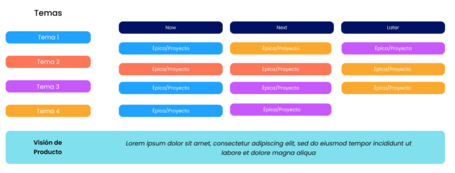
As you can see, each theme is represented, and within each column (Now / Next / Later), projects are shown in the color corresponding to their initiative.
Additionally, below the roadmap we display the product vision, since it is essential to keep it in mind when building the roadmap.
Timeline-based roadmap
These roadmaps use a time scale or timeframe, which can vary depending on the needs of your product or project: 3 months (short term), 6 months (mid term), 12 months (long term), or even per sprint if you work with Scrum.
Our advice is not to plan your roadmap more than six months ahead, because the idea behind a roadmap is agility. You should be able to adapt it based on feedback and new needs that arise.
Here is a visual example of a timeline-based roadmap 👇
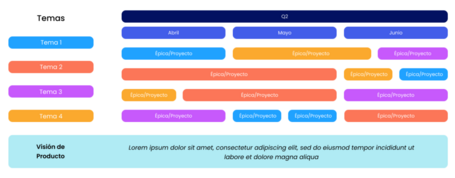
In this example, we see a roadmap with four different initiatives that will be developed during Q2. Each initiative or theme has a different color indicating which project or epic it belongs to.
Just like in the previous type of roadmap, the vision is included to ensure it is always considered during roadmap development.
In this case, the months are also included, helping provide transparency and alignment with stakeholders and the team.
Key elements
As you’ve seen, regardless of the type of roadmap that best fits your product or project, its core elements are the same:
- Time scale, whether a timeline or a Now–Next–Later format.
- Themes or initiatives at a high level.
- Projects or epics for each initiative.
And don’t forget to reflect your product vision!
Next steps
Although we haven’t mentioned it earlier in this post, there are other important aspects when creating a roadmap:
- Prioritization. We cannot do everything, and certainly not all at once. That’s why we must make decisions and prioritize initiatives. There are different techniques and frameworks that can help with this, as we explained in this post 👉 Unlocking the potential of prioritization: the most important frameworks.
- Communication. The main value of building a roadmap is that it acts as a tool for alignment and transparency. It helps everyone understand the focus and why certain decisions are made.
- Connection with the business. Every initiative must be linked to a business objective; otherwise, we risk investing time in developments that generate no real value. To achieve this connection, it’s important to stop thinking about outputs and start focusing on outcomes — generating real impact by solving specific problems and needs.
There is still much more to say about this last point, which we’ll cover in future posts 😉.
Conclusion
A roadmap is a tactical tool that aligns product vision with strategy.
Also keep in mind that no roadmap is better than another. You simply need to adapt it to the specific needs of each project and continue iterating until you find the roadmap that best fits your product.
A roadmap is a compass. Build yours!

Iria Calvelo
I’m a Computer Engineer and began my professional journey as a developer before becoming a Product Owner, the role I currently hold at Paradigma Digital. My passion for technology and digital products is complemented by my experience working in startups and various product companies, especially in B2B businesses. I aim to create impact in large organizations by building products that deliver real value to users through a customer-centric approach.
View more of Iria.More thoughts about this.
Read more.
Real transformation or fake transformation?

Why should your teams be multifunctional?
Estimates, reality or fiction?
Reinvention of agile contracts: inspection and adaptation.
Comments are moderated and will only be visible if they add to the discussion in a constructive way. If you disagree with a point, please, be polite.

Tell us what you think.