
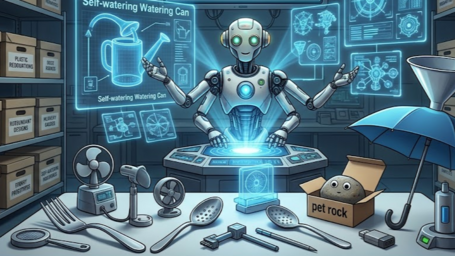
I recently worked with an LLM on a software architecture project. These days, using one is essential for boosting our accuracy, breadth, and productivity.
The conclusion is uncomfortable for both ends of the spectrum: employees afraid of losing their jobs, and decision-makers who, chasing cost savings, are laying off entire teams. AI is extraordinarily capable.
But there's one thing it's completely incapable of: making the right calls when nobody's steering. As I've said before, AI is our copilot, but the decisions are ours.
The context
I laid out the initial context: "SaaS platform for centralized record management, integration with external channels, subscription model." Working from an architecture PNG and 4 analytics spreadsheets as context, I pulled together a map of the client's current architecture, without much of a clue yet as to what path we'd end up taking.
After 2 meetings to figure out what the client wanted, and following those classic kickoff sessions where we dream up "ideal" solutions, we landed on a 15-microservice architecture. Documented APIs, data models, databases all designed.
Consistent down to every line, with an incredible level of detail.
It included a Transaction Service with Redsys (I steered it toward this solution based on integration level, since I'd spent several years working with payment gateways), an Analytics Service with an ROI dashboard, a Billing Service with Free/Premium/Enterprise tiers. The exact solution any architect would design facing those requirements. Ambitious, coherent, consistent — nothing a specialist could really object to.
Technically flawless.
After presenting the initial sketch, the validation process with the client revealed that the market and the business model called for a more measured approach. Transforming a business model is a complex process that demands moments of reflection to align the technology with day-to-day operational reality.
Strategic decisions get made by the people who live the business. Our role is to support that vision, understanding that technical design has to be an enabler, not an obstacle.
Iterating and adjusting scope
In an iteration-based process, the goal is to surface the possibilities that open up, letting the client decide which battles to fight at each stage. After analyzing the context, we decided to adjust the project's scope:
- Prioritization: we identified functionality that, while valuable down the road, wasn't critical for the immediate launch.
- Optimization: the roadmap was simplified, going from 15 services down to 3 essential ones, ensuring a more agile, realistic path to production.
- The human factor: this decision came out of human judgment and commercial instinct — things technology alone can't replicate.
AI's role as support, not as guide
This case underscored how important direct communication is. AI, while extremely efficient at refining technical solutions, depends entirely on human strategic direction. When we pivoted to the new model, the technology adapted within hours, but the vision for that change was born out of meetings and notes shared between people.
The pattern that keeps repeating: volatility
This course correction isn't an isolated event — it's a constant in building high-level solutions. Over my 20 years in the field, I've seen firsthand that prioritization is a living organism: budget changes, technical challenges, or strategic pivots in the business model are our daily bread. What gets defined as essential today can stop being essential tomorrow, in favor of the project's viability.
In this landscape, the human factor is irreplaceable. Without precise communication of these changes, technology — and specifically AI — is limited to refining the instructions it was given before. AI is a management amplifier: if direction isn't updated with precision when the business throws a curveball, we risk amplifying the mistake instead of the win.
That's why the key to success isn't just technical capability — it's the agility to communicate a change in context and pivot the technology in real time.
The power of asking the right questions
A critical turning point came up in the technical proposal. The AI, working off abstract architecture patterns, initially suggested replacing the central record-management system with a new, independent microservice. The logic made sense from a theoretical standpoint: split off a consolidated system to modernize it.
However, after looking at how mature and stable the current system actually was (a platform with years of iterations behind it and multiple critical integrations), the strategic question shifted: do we actually need to replace what already works, or is it more efficient to evolve it?
The solution: hybridization and a focus on value
Instead of a full replacement that would have meant months of unnecessary risk and cost, we went with a smart-coexistence approach:
- Preserving the core: keeping the current system as the single source of truth, leaning on its robustness and stable APIs.
- Targeted innovation: designing a new, dedicated microservice for the new functionality that was actually the core of this evolution.
- Delivery agility: thanks to this "divide and conquer" approach, we were able to present a solid, validated execution plan even two days ahead of schedule.
This decision shows that AI can produce the textbook architecture, but only human judgment can determine whether that architecture fits the client's actual context. AI churned out the documentation and models for this new scheme in record time, but the strategic call to keep what delivers value and build only what's necessary is what made the proposal a success.
Why mass layoffs are a logic error
Organizations cutting technical teams because "AI does it now" are confusing execution speed with the ability to direct. As productivity rises, where two development roles used to be needed, now one person with good judgment will do. Does that affect us? Of course it does — but like everything in life, I think there's a middle ground.
AI brings speed. But direction is still a human responsibility, or it isn't direction at all.
A team of 5 people with well-directed AI produces more than a team of 20 without it. Cutting that team of five down to zero doesn't multiply productivity. It destroys it.
What disappears when you remove the person who actually understands isn't the code or the academic design — you eliminate common sense. That's the ability to know whether what you're proposing is really what you need.
The real shift
AI doesn't make technical knowledge irrelevant. It makes technical knowledge without judgment irrelevant.
What it amplifies is the capability of someone who:
- Understands the business and its constraints
- Knows what not to do (that's the hard part)
- Can communicate changes to the team
- Recognizes when the context has shifted
That person, with AI, produces what an entire team used to produce. But only if they know how to direct it. What matters isn't proposing components or writing code — it's deciding which components are actually needed, or what code to write. That's simply more visible now. AI executes at a speed that doesn't forgive a lack of direction: an architecture that used to take months to reveal its flaws now reveals them in weeks.
Conclusion
I don't think AI is going to replace people who know what they're doing. I think it's going to make the people who genuinely know what they're doing a lot more visible.
AI is an extraordinary amplification lever, but its real power lies in the fact that it amplifies whatever you feed into it. It's a multiplier of intent: apply good judgment, and you get an augmented, precise vision; apply confusion, and all you'll get is chaos scaled at a speed no human team could ever match.
In the project I described, AI didn't work instead of people. It worked with someone who knew what to ask, when to change course, and how to communicate decisions, at a speed that would have previously required an entire team.
The difference between that and a disaster came down to a handful of human decisions made at the right moment.

Raúl Martínez
Computer Engineer with 20 years of experience in application development and leading multidisciplinary teams. After 8 years at Indra, where he worked on projects for the Ministry of Education, DGT (General Directorate of Traffic), RFEF (Royal Spanish Football Federation), and SELAE (State Lotteries and Gambling), he saw Paradigma as an opportunity to continue growing and developing as a professional. Now, after 10 years at the company and having deepened his knowledge of various technologies and work methods, he looks forward to continuing to improve and learn in this wonderful profession.
View more of Raúl.More thoughts about this.
Read more.
OpenAI levels up voice-based models.

Technology trends: what’s in store for 2022?

The Importance of Prompt Engineering.

RAG Isn't Dead, It Just Grew Up.
Comments are moderated and will only be visible if they add to the discussion in a constructive way. If you disagree with a point, please, be polite.

Tell us what you think.