

Making software work correctly and ensuring that work processes follow a quality-oriented methodology are not the only goals that should be pursued within QA, QC & Testing and in the software world in general. There is a new frontier: measuring quality in watts and CO₂.
Testing everything at all times may not be the most optimal or the most ecological approach. Improving testing cycles and adapting both process quality and product quality to reduce emissions becomes a new challenge for teams.
In this series of three posts about Green Quality Assurance, we will explore this new perspective to understand what it consists of, which frameworks may be most suitable to achieve our goals, and how to establish KPIs and metrics within an organization or project to guide our practices toward greater efficiency and sustainability.
In this first part, we will focus on explaining what it means to be environmentally conscious in the QA world and how this need arises, driven by European regulations such as CSR (Corporate Sustainability Reporting Directive) and concepts like ESG (Environmental, Social, and Governance).
What is Green QA?
Imagine your quality process becoming an “athlete”: faster, stronger, and much more efficient. Green Quality Assurance (GQA) redefines QA, QC, and testing processes so that each one matters, reducing energy consumption and carbon footprint without losing the rigor required.
Integrating sustainability into the quality of the process (QA activities during software construction) and into the quality of the product (QC and testing, validating and verifying the built product) means ensuring that software is not only good in terms of quality, but also efficient in terms of energy consumption and sustainability, and aligned with ESG principles, which we will explore later.
Organizations that integrate social responsibility into their development lifecycle, while maintaining performance and controlling costs, present a competitive advantage to potential clients. This allows those clients to improve their sustainability metrics without sacrificing other objectives.
Aligned with the concept of GQA is GreenCode, which focuses on coding practices that seek energy efficiency through techniques such as lazy loading, microservices instead of monoliths, and lightweight code that extends the lifespan of the devices on which it runs, among other aspects.
Green IT goes hand in hand with the above concepts and serves as their foundation. It refers to the use of hardware with high energy efficiency certifications and the use of cloud infrastructure, since large providers such as Amazon and Google often rely partly on renewable energy sources like solar power to maintain their data centers.
Currently, from a legal perspective, there are regulations that require companies to present CSR reports (or Sustainability Reports). At the European level, this is known as the CARD directive, which in Spain has been mainly integrated through the Corporate Sustainability Reporting Law (LIES). It is important to remember that the CARD directive requires the use of ESRS standards (European Sustainability Reporting Standards). These standards require certain companies to break down their energy consumption and emissions depending on the size and type of company. As you can see, Green QA has legal coverage and, if its objectives are achieved, it helps companies comply with these requirements.
As an example of the use of these regulations and Green QA, a traditional CSR report might say: “we want to be green,” while a report under the CARD directive would require something like: “our Green QA suite reduced CPU consumption by 12%, saving X tons of CO₂ this year.”
ESG as DNA
Continuing with the concepts surrounding GQA, and since we will refer to it frequently, let’s briefly explain what ESG is.
ESG (Environmental, Social, and Governance) is the set of criteria that investors, governments, and customers use to measure whether a company is responsible in terms of environmental impact, social responsibility, and internal governance.
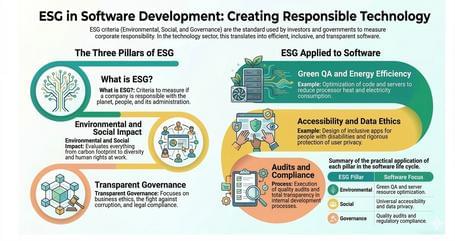
When we talk about Environmental, we refer to the environmental impact a company has on the planet. Green QA plays a significant role here, helping with aspects such as:
- Key topics: carbon footprint, energy efficiency, waste management, and climate change.
- In software: how much energy do your servers consume? Is your code optimized to avoid unnecessarily heating processors?
When we talk about Social, we refer to how the company manages its relationships with people and society.
- Key topics: diversity, human rights, workplace safety, and data protection.
- In software: this includes accessibility (ensuring that people with disabilities can use your application) and ethical data practices (user privacy).
Finally, when we talk about Governance, we refer to how the company is managed internally — the rules and transparency that guide its operations.
- Key topics: business ethics, executive compensation transparency, anti-corruption measures, and legal compliance.
- In software: quality audits, compliance with software regulations, and transparency in development processes.
Now that we understand ESG, we can see how the technical quality role can evolve — from guaranteeing the method and the product to also ensuring ESG compliance, thereby becoming a guardian of sustainability as well.
Understanding the major ESG pillars (environmental impact, social impact, and internal governance), GQA helps achieve objectives in the technological domain:
- 🍃 Environmental: optimizing automated test suites and improving cloud efficiency to directly reduce the software’s carbon footprint.
- 🤝 Social: promoting digital inclusion. Efficient code consumes fewer resources and performs better on older devices, helping combat planned obsolescence.
- ⚖️ Governance: generating technical metrics and transparent reports on energy consumption, facilitating compliance with green audits.
Organizations that align their quality lifecycle management processes with ESG goals without compromising speed, cost, or performance will gain a decisive advantage in a market increasingly saturated with high-performance CSR requirements.
Main objectives
The main objectives of this philosophy are resource optimization, operational efficiency, and profitability. Among the goals pursued are reducing environmental impact by lowering consumption, reducing waste and emissions, and optimizing the use of material and computational resources.
We know that every time a test suite runs (especially in the cloud or on large servers), electricity is consumed, which generates a carbon footprint. Reducing this impact through selective testing and efficient test code should be a key goal.
Another objective of Green QA is alignment with ESG, providing environmental metrics:
- Enabling auditable sustainability reports (test cycle consumption, etc.)
- Providing insights for sustainable data governance (reducing data duplication in TDM test environments), which lowers physical storage requirements in data centers.
- Providing audit trails proving that quality processes comply with the organization’s “Net Zero” policies.
Impact areas: where quality becomes green
To achieve Green QA objectives, we must intervene in key digital assets. It’s not only about verifying that software works — it’s about ensuring it is sustainable. To do so, we must act in the following areas:
Validation of digital products and processes
- Software lifecycle analysis (S-LCA): QA no longer only validates the “Go-Live”; it audits environmental impact from development and testing through deployment and eventual software decommissioning. Its role is to ensure that energy consumption calculations at each stage are accurate and realistic.
- Code sustainability verification: implementing protocols to measure the “energy density” of functions. QA performs efficiency tests to prevent bloatware and ensure the product does not force user hardware obsolescence.
Sustainability audits in infrastructure
- Cloud provider validation: QA verifies that the infrastructure hosting the software complies with renewable energy certifications (PUE – Power Usage Effectiveness). We don’t just test in the cloud — we audit that the cloud is green.
- Optimization of the digital supply chain: reviewing third-party libraries and dependencies. Green QA detects inefficient dependencies that consume resources in the background without delivering value.
Validation of eco-design in software
- Repairability and modularity criteria: validating that code is structured so it can be easily maintained and updated without refactoring the entire system, saving unnecessary computation cycles.
- Data transfer efficiency: specific tests to reduce the weight of API requests and data traffic, directly lowering electricity consumption in data centers and telecom networks.
- Carbon-aware load testing: measuring not only how many users the system supports but also how much CO₂ the server emits under that load.
Ensuring ESG data integrity
For a sustainability report to be valid, the data must be highly accurate. Green QA becomes the technical auditor ensuring the integrity of every metric, which requires proper training for this role to certify the provided information.
- Validation of emissions KPIs
The QA profile must ensure that calculation algorithms and data sources reflect the real energy consumption of the digital ecosystem:
- Direct emissions: first level. Validation of data from proprietary infrastructure and on-premise servers.
- Purchased energy: second level. Verification of electricity consumption reports from contracted data centers and their energy mix (renewable vs. fossil).
- Value chain: third level. The biggest challenge. QA audits the efficiency of third-party APIs and the energy consumption generated by the software on end-user devices.
- Accuracy and reliability of reports
Having data is not enough — it must be correct. Techniques are applied to prevent bias in sustainability reports:
- Stress testing of carbon footprint calculation models.
- Validation to ensure there are no duplicated emissions counted across departments.
- Traceability and auditing (Data Lineage)
Implementation of traceability tests to ensure that every data point in the annual report can be traced back to its technical origin (server logs, CPU metrics, etc.). If an auditor asks where a number comes from, Green QA has the documented answer.
- Consistency in ESG disclosure
Ensuring that the data published on the website, in the app, and in the legal CARD directive report are identical. Automated cross-validation processes should be implemented to avoid discrepancies that could result in legal penalties.
Application of standards and regulations
Several frameworks and standards support the implementation of these “green” processes. Here we briefly review them; in future articles we will explain how they can be applied strategically and methodologically:
- ISO frameworks (14001 and 50001): ensuring QA processes are documented to pass external environmental and energy management audits.
- CARD (Corporate Sustainability Reporting Directive): the new European regulation ensuring legal sustainability reporting requirements are technically fulfilled.
- EU Taxonomy: validating that company activities are correctly classified as “green” according to EU technical criteria.
- GHG Protocol (Greenhouse Gas Protocol): establishing the standard methodology for calculating carbon emissions derived from the software lifecycle. QA must validate energy consumption data collection in Scope 2 (server/cloud energy) and Scope 3 (third-party cloud services and end-user software usage), ensuring emission factors are accurate for carbon footprint reports.
Conclusion
We have seen how, within the world of software quality, there is an aspect that is rarely considered yet has a significant impact.
Applying GQA not only improves sustainability but also enhances efficiency, which ultimately reduces costs in both processes and product development.
All these processes are supported by a set of European regulations and their transposition into Spanish law, making them even more relevant since non-compliance can result in financial penalties for companies.
Ultimately, Green QA is about doing our part to improve life through quality practices.

Santiago López
I am a Technical Engineer in Computer Science and, although my professional career was dedicated to development for many years, I later transitioned into QA. From that role, I have spent many years supporting projects and pursuing continuous improvement. Outside of work, I dedicate my time to my family. I enjoy going for a run when I can, and for the past few years I have practiced kajukenbo to stay in shape and, on some days, to release some tension.
View more of Santiago.More thoughts about this.
Read more.
Improving test quality with mutation testing.

QA in IoT: How to Ensure Reliability in a Connected World.

Platform as a Product: Scaling DevOps with IDPs.

AIOps applied to CI/CD: when the pipeline decides something is wrong.

Comments are moderated and will only be visible if they add to the discussion in a constructive way. If you disagree with a point, please, be polite.

Tell us what you think.