

The Web Content Accessibility Guidelines (WCAG) are the reference standard that defines how to create accessible web applications for everyone, regardless of their abilities or the context in which they browse.
We are currently on WCAG 2.2, published as a recommendation on October 5, 2023, and until now the approach behind these guidelines has remained fairly stable.
Up to this point, the model has been relatively straightforward to understand: on one hand, there was a set of technical criteria defining which aspects a website needed to meet in order to be accessible, and on the other, different conformance levels (A, AA, and AAA) indicating the degree of accessibility achieved.
But this is changing, and that is precisely why I wanted to write this article.
It has now been more than five years since the publication of the first draft of WCAG 3.0, and although it is still exactly that—a draft—the proposal is beginning to take shape and giving us a glimpse of where digital accessibility is heading.
Before continuing, I want to clarify that this is not yet an official standard and should not be used as a legal or compliance reference. For now, organizations should continue working with WCAG 2.2.
How Accessibility Evaluation Changes in WCAG 3.0
I think the best way to understand what I mean by “this is changing” is to analyze how accessibility will be evaluated in WCAG 3.0. Because beyond new criteria or small technical adjustments, what is truly changing is the way we understand accessibility.
Conformance
From WCAG 1.0 through to WCAG 2.2, the system for determining whether a website was accessible has remained almost unchanged: there was a set of success criteria, and depending on which ones were met, a given conformance level was achieved.
These levels were:
- A. This is the minimum conformance level and is achieved when the website complies with all Level A success criteria.
- AA. This level is the minimum legal requirement for most websites that are required to be accessible. It is achieved when all Level A and AA criteria are met.
- AAA. This is the highest accessibility level and is achieved when all A, AA, and AAA criteria are met.
However, WCAG 3.0 proposes abandoning this traditional model and replacing it with a new level system:
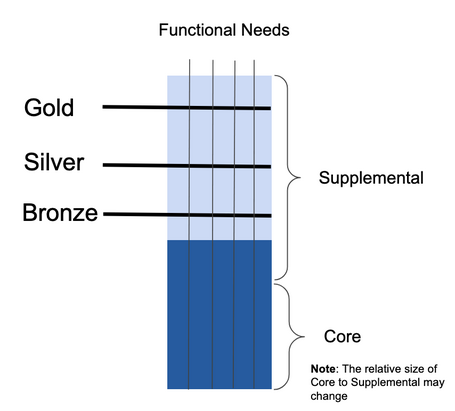
- Bronze. This would become the minimum conformance level. To achieve it, all pages, views, and processes included within the evaluation scope must meet all core requirements plus a portion of the supplemental requirements and assertions defined within each Functional Performance Statement.
- Silver. To achieve this level, all core requirements must be met along with a greater proportion of supplemental requirements and assertions than in Bronze.
- Gold. This would become the highest conformance level within WCAG 3.0. It would require meeting all core requirements and nearly all applicable supplemental requirements and assertions.
You can read more about the WCAG 3.0 conformance requirements in the draft.
Later in this article I’ll explain in more detail what core requirements, supplemental requirements, and assertions mean in WCAG 3.0. For now, the important thing to understand is that the current model works in a binary way: a criterion either passes or fails.
However, this new version (WCAG 3.0) aims to move away from that approach and proposes a much more flexible and progressive system based on scoring, outcomes, and real accessibility experiences.
Functional Performance Statements
This new version introduces the concept of Functional Performance Statements, which broaden the way accessibility is understood. You can read more about Functional Performance Statements in the draft.
These statements are not technical criteria as in previous versions, but rather descriptions of how a person can interact with technology based on their functional capabilities, regardless of a specific disability.
The goal is not to produce a list of disabilities but to describe functional limitations that may occur in different contexts and may affect anyone, whether permanently, temporarily, or situationally.
For example, a person with a visual impairment may need “use without vision,” but someone using a mobile phone under bright sunlight with poor visibility may encounter a similar situation.
Types of Provisions
Finally—at least within the scope of this article—version 3.0 also introduces a new concept called Types of Provisions, which defines how different requirements are evaluated and weighted within the conformance model.
These provision types include:
- Core requirements. These are the aspects considered essential for an accessible experience. If any of these requirements fail, conformance cannot be achieved regardless of the total score obtained.
- Supplemental requirements. These are aspects that enhance the accessibility experience but whose absence does not completely invalidate conformance. They help measure the overall quality of the accessible experience.
- Assertions. These are additional declarations made by the organization itself to demonstrate accessibility practices that cannot always be validated automatically.
Each of these has a different weight and purpose within the new evaluation system proposed by WCAG 3.0.
Conclusions
WCAG 3.0 is still in draft status, but it already points to an important shift in the way we understand digital accessibility.
Beyond new levels, new terminology, or new metrics, what truly changes is the approach: we move from a model based on strict technical compliance to a model more focused on outcomes, context, and real user experience.
This does not mean WCAG 2.2 becomes irrelevant—quite the opposite: it remains the current standard and the active reference for web accessibility. But understanding where WCAG 3.0 is heading helps us anticipate how digital product design and development will evolve over the coming years.
That said, I hope you enjoyed this article and that it helped you better understand what we can expect from the new version of WCAG. I’d love to hear your thoughts in the comments!

Vanessa Davo Parreño
I’m a multimedia engineer working as a software developer and UI/UX designer. I see technology as a tool to build more just, equitable, and accessible spaces. I’m a creative and curious person, so I love continuously learning, especially when it comes to exploring new ways of creating.
View more of Vanessa.More thoughts about this.
Read more.
Target Size: The Great Overlooked Aspect of Accessibility.

How can I make my app accessible?

How to Make My App Accessible: Current Standards.

if() in CSS: a key tool for frontend development.

Comments are moderated and will only be visible if they add to the discussion in a constructive way. If you disagree with a point, please, be polite.

Tell us what you think.