
Introduction to the Human–Machine Interaction Paradigm
The development of conversational systems represents one of the most transformative scientific and technological trajectories within the fields of AI and NLP. For decades, computer science has pursued the ambition of giving machines the ability to understand, interpret, process, and generate human language with all its inherent structural richness.
This historical evolution has progressed through several radically different approaches. It began with rigid systems based on structural heuristics, moved through the adoption of statistical and probabilistic models, and ultimately arrived at the deep learning neural architectures that dominate today’s scientific landscape.
Analyzing this progression reveals a profound transformation in how language is represented. In its early stages, language was treated as a sequence of symbols governed by syntactic rules. Over time, this deterministic view gave way to a stochastic understanding, where words became probability distributions. Today, language is mathematically conceived as a multidimensional semantic space that can be encoded into vectors.
This transition has enabled machines to capture subtle nuances, long-range dependencies, and contextual information in ways that mimic—and in some classification and generation tasks even surpass—the processing capabilities of the human brain.
In this series of posts, we will examine the foundational milestones that have shaped the evolution of conversational systems.
ELIZA, the First Conversational Assistant
During the early stages of artificial intelligence, throughout the 1950s and 1960s, it was widely assumed that machine understanding of human language could be achieved through the encoding of grammatical rules, syntactic dictionaries, and algorithmic decision trees. Within this context emerged ELIZA (1966), the first truly disruptive milestone in the simulation of conversational interactions.
ELIZA was designed as a research platform for studying natural language communication between humans and machines. It possessed no ontological understanding of the meaning of the words it processed. Instead, it implemented a system based on lexical pattern recognition and textual sequence matching.
The architectural core of ELIZA relied on a set of rules triggered by the detection of keywords within the user's input text. Once the system identified a keyword within the input string, it activated the rules associated with that keyword to generate a response that appeared superficially coherent and connected to the original statement.
To create this illusion of interactive understanding, its creator had to structure the system around five technical challenges that, in retrospect, laid the operational foundations of all early conversational systems:
- Algorithmic identification and prioritization of keywords within a sentence.
- Discovery and isolation of the minimum context required to generate an appropriate response.
- Selection of syntactic transformations to reverse pronouns (for example, transforming "my" into "your").
- Generation of generic predefined responses when no recognizable keywords were found in the user's input.
- Modular editing capabilities that allowed programmers to update and expand the program's scripts dynamically without rewriting the core engine.
ELIZA’s most famous and extensively studied script, known as DOCTOR, simulated interactions with a Rogerian psychotherapist. Its role focused on reflecting the patient's statements through open-ended questions and reformulations. In doing so, it almost completely eliminated the need for the system to introduce new real-world knowledge or generate invented judgments.
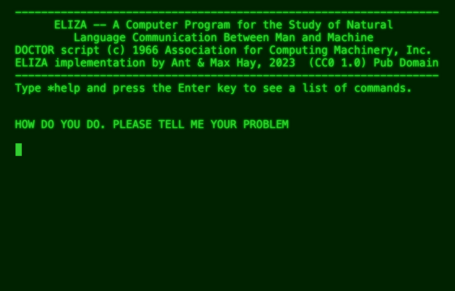
Despite its complete dependence on pattern matching and its lack of long-term contextual memory, ELIZA conveyed a psychological illusion of empathy, intelligence, and deep understanding to its users. Many people, including members of the research laboratory itself, developed emotional attachments to the program and shared personal confidences with it.
This phenomenon of anthropomorphizing computer systems was later coined in scientific literature as the "ELIZA Effect."
Despite ELIZA’s success, the limitations of purely rule-based approaches quickly became apparent to the research community. Everyday linguistic phenomena such as polysemous ambiguity, irony, sarcasm, dependence on pragmatic context, anaphora, and the infinite structural richness of human syntax made it impossible to compile a manual rule set comprehensive enough to handle every possible conversation.
The scalability of these systems was effectively nonexistent. Adding new rules often generated logical conflicts with existing ones, causing systems to fail. A transition toward systems capable of learning from data rather than relying on manually encoded knowledge became urgently necessary.
The Stochastic Transition: Statistical Models and Early Machine Learning Approaches
To overcome the rigidity of rule-based systems, the field of NLP underwent a major transformation during the 1980s and 1990s. The scientific community progressively adopted statistical models and pioneering machine learning approaches. These techniques, based on n-gram models and other probabilistic methods (such as HMMs, Hidden Markov Models), enabled researchers to overcome some of the limitations of purely rule-based systems.
This new paradigm abandoned the manual formulation of grammatical rules in favor of the automatic extraction of co-occurrence patterns from large structured text corpora. The underlying idea was that grammar and meaning did not need to be explicitly encoded if they could be statistically inferred by observing how people actually use language in practice.
An n-gram model seeks to predict the statistical probability of a specific word appearing given the sequence of words that immediately precedes it. This approach is based on the Markov assumption, which simplistically states that the probability of a future state (the next word) depends solely on a limited number of immediately preceding states, completely ignoring the broader historical context beyond that window.
Although these probabilistic models enabled machines to generate text autonomously and significantly improved accuracy in critical tasks of the era such as automatic speech recognition, spell checking, and machine translation, they still suffered from important mathematical limitations.
The most notable was the data sparsity problem. As the context window increased in size to capture longer and more complex grammatical dependencies, the probability of encountering that exact sequence of words within the training data decreased exponentially.
While stochastic and probabilistic techniques represented a monumental leap beyond rule-based systems, they still suffered from a representational limitation. The computational representations commonly used during this period were sparse vectors based on one-hot encoding, where each word in the vocabulary corresponded to a vector whose length matched the size of the entire known vocabulary (often tens of thousands of dimensions), with a single value of "1" at the index corresponding to the word and "0" everywhere else.
For the machine, this binary representation conveyed no semantic similarity. The statistical model had no structural way of recognizing that the words "dog" and "cat" belong to a similar semantic category as domestic animals, treating them with the same conceptual distance as it would between "dog" and completely unrelated words such as "car" or "water treatment plant."
As a result, for the system to learn the properties of each word independently, it required extremely large volumes of data.
Conclusions
The evolution of the earliest conversational systems demonstrates that brute force never surpasses technical adaptability. The transition from architectures based on manually crafted rules to probabilistic engines laid the foundations for modern automation.
In the next post, we will continue our chronological journey through the evolution of conversational systems and Natural Language Processing.
References and Resources

José Luis Palomino
My profile is the result of combining my passion for language (Bachelor’s degree in English Studies) with the world of technology (Master’s in NLP and AI). Currently, as a Prompt Engineer at Paradigma, I design how we communicate with language models. Some of my responsibilities include optimizing latency, managing cost per token, selecting the most suitable model based on context, and rigorously evaluating its behavior to consistently ensure the best results in production.
View more of José Luis.More thoughts about this.
Read more.
Retrieval Augmented Generation and its corporate usage.

Langfuse vs. LangSmith II: Datasets and Evaluation.

From Conversation to Execution: 7 AI Trends for 2026.

The Importance of Prompt Engineering.

Comments are moderated and will only be visible if they add to the discussion in a constructive way. If you disagree with a point, please, be polite.

Tell us what you think.