

When I first discovered microfrontends a few years ago, I thought I had found the ultimate solution to all my frontend architecture problems. Spoiler: it wasn’t. Not because they’re a bad technology, but because, like everything in software development, they come with a price that isn’t always mentioned when people talk about implementing them.
If you’re considering implementing microfrontends in your project, or if you already have them and feel identified with the chaos I’m about to describe, this post is for you.
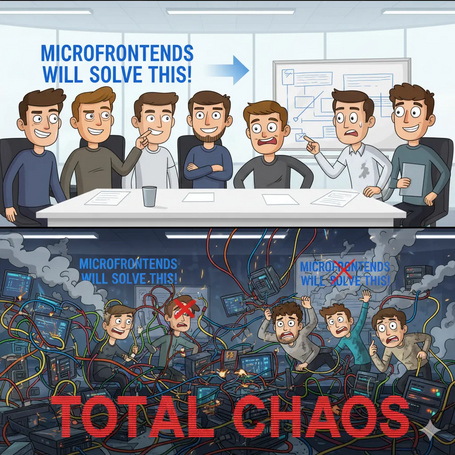
The Promised Dream
Let’s start with the beautiful part. Microfrontends arrive with a brilliant promise:
- Full autonomy for each team
- Independent deployments without stepping on others’ code
- Organizational and technical scalability
- Different technologies coexisting in harmony
- Clear ownership by business domains
It sounds perfect, right? And in theory, it is. Each team builds its own slice of the frontend, deploys whenever it wants, uses the framework it prefers, and everything works like a Swiss watch.
Until it doesn’t.
When Reality Hits
The truth is that the real complexity of microfrontends isn’t in the code, but in everything else: teams, blurry boundaries, maintenance, coordination.
Let me tell you what no one mentions when they sell this architecture as the silver bullet.
1 The Complexity You Didn’t Expect
"We went from having one big monolith that was hard to maintain to having 10 small monoliths that are hard to coordinate."
Suddenly you have:
- A multiplication of CI/CD pipelines (one per microfrontend).
- Versioning nightmares with shared libraries.
- Communication strategies between microfrontends that no one properly documented.
- Dependency synchronization issues breaking things everywhere.
What used to be a problem in one place is now ten distributed problems. And distributing problems doesn’t make them disappear, it makes them harder to find.
2 The User Experience Becomes Fragmented
"Each microfrontend is independent… until the user notices they all have different spinners."
Every team has its own priorities, pace, and way of doing things. The result:
- Visual inconsistencies everywhere.
- Uneven performance (one loads in 200ms, another in 3 seconds).
- Interactions that don’t feel cohesive.
- Global changes (like a rebranding or accessibility improvements) turning into near-impossible missions.
In the end, users don’t know or care that you’re using microfrontends. They just know your app feels weird.
3 Integration and Security: The Constant Headache
Sharing authentication between microfrontends is more complex than it seems:
- Token handling across domains or contexts.
- Cookies that work in development but break in production.
- Sandboxing issues when using iframes (and all the problems that come with them).
- Permissions and roles that must stay synchronized.
And all of this while trying to keep things secure. Guaranteed fun.
4 The Invisible Cost
Microfrontends aren’t free. They carry a cost that isn’t always visible at the beginning:
- Onboarding time multiplies (now you need to understand N architectures).
- Duplicated dependencies that bloat your bundles.
- Longer build times because everything is built separately.
- More complex infrastructure to maintain and monitor.
Oh, and your cloud bill? It grows too.
5 The Human Factor (The Most Important One)
"Microfrontends don’t fix misaligned teams, they just make the problems more visible."
This was the hardest lesson for me: architecture does not solve organizational problems.
If your teams don’t communicate, if there are no clear agreements, if ownership boundaries are blurry… microfrontends will only amplify those issues:
- Conflicts over who owns what.
- Duplicated work because teams don’t know what others have already built.
- Technical inconsistency that turns into distributed technical debt.
In the end, you’re left with frustrated development teams arguing with each other.
So, What Do We Do?
I won’t leave you with a bitter aftertaste. Microfrontends can work, and despite how it may sound, I don’t hate them at all. But you need to carefully evaluate whether you truly need them and be willing to invest in doing them right.
Here are some lessons I’ve learned:
- Evaluate whether you really need them
If your team is small or medium-sized, you probably don’t. A well-structured monolith can take you very far.
- Establish clear contracts
APIs, events, interfaces… everything clearly defined and documented. Without this, you’re heading straight into chaos. A well-organized Architecture team is your best ally.
- Communication
Having people who act as bridges between different development teams (business domains) is essential for things to flow smoothly.
- Unify the experience
Invest in a solid design system and shared base components. Consistency is non-negotiable.
- Automate everything you can
Your pipelines, deployments, versioning, tests. Complexity is only manageable if it’s automated.
- Organization first, technology second
Microfrontends should reflect how your organization works, not the other way around. Remember Conway’s Law: your architecture will inevitably mirror your organizational structure.
In Conclusion
As architects, we shouldn’t focus only on the technical impact on the final product (scalability, resilience, etc.), but also on the Developer Experience. Our goal should be to provide the right tools and the necessary support so development teams can work efficiently and effectively.
Microfrontends are not the villain, but they’re not the hero that will save your project either. They’re just a tool. And like any powerful tool, you need to know when to use it… and when to leave it in the box.
The real question isn’t “Are microfrontends good or bad?” but rather:
“Do they solve the concrete problems we have right now and are we willing to pay their cost?”
If the answer is yes then great, use them. If not, that’s fine too: sometimes the best architecture is the simplest one that works.

Rodrigo Zavala
Frontend Architect with experience in designing and developing scalable web architectures. I’m passionate about new technologies, architectural patterns, and development best practices. An early adopter by nature, I’m always experimenting with new tools and approaches. I actively participate in tech events and communities to keep learning and share knowledge.
View more of Rodrigo.More thoughts about this.
Read more.
The extinction of the front developer profile.

Ebook - Technical SEO for web developers.
Howto: Hadoop Streaming with Ruby and Wukong.
The TIOBE Index: How do you measure which programming languages are the most used?
Comments are moderated and will only be visible if they add to the discussion in a constructive way. If you disagree with a point, please, be polite.

Tell us what you think.