

Writing to a language model seems easy until it starts returning unusable text. Many people believe it is enough to type a couple of lines as if they were talking to a coworker, but reality is very different. If we want to apply best practices and start building real business solutions, we need to focus on implementing a structured methodology from day one.
Why Does AI Return Noise Instead of Solutions?
We are transitioning from deterministic programming to the probabilistic environments of large language models, and this completely changes the way we approach many tasks.
Interacting with this technology as if there were a human on the other side interpreting our intent is the fastest path to failure. When we provide vague instructions, the system returns noise and empty answers that deliver no real business value. This lack of precision is often unfairly labeled as an incomprehensible "black box."
To avoid this operational nightmare, we must start treating our text requests as pieces of software code—something similar to pseudocode. In this post, we will explain how to reduce the deviations and hallucinations we face when working with any language model.
Why Do We Need to Break Down and Delimit Context?
Plain, unstructured text often causes the model to lose focus and mix instructions with raw data. This jumble of information undermines the reliability of the final result, especially when using medium-sized or small models. The most effective way to address this issue is modular segmentation.
Leading companies strongly recommend separating context, rules, and input data using explicit delimiters. Using XML tags or simple Markdown markers helps the model process each block as clearly as possible. By creating a clear contract between inputs and outputs, we limit the margin of error.
How Do We Control Style and Ensure Integration?
Beyond structuring information, we need to govern the way the system communicates. Based on effective design patterns, assigning a specific role or persona forces the AI to activate a particular subset of its training. Giving it an expert identity transforms a generic response into a deeper analysis tailored to our domain.
It is not enough to ask it to act as a developer or consultant. We should also define the level of formality, perspective, and expected level of detail. If we request a conversational tone without corporate jargon, the content becomes far more digestible.
Likewise, if we want to connect the response with an external application, enforcing a structured output format is non-negotiable. Requiring rigid formats such as JSON ensures interoperability with other components of our software. Models respond far better to positive, imperative instructions that specify exactly what they should do rather than long lists of prohibitions.
What Are Examples Really Useful For?
Expecting a model to solve complex problems correctly on the first attempt and without references is often too optimistic in enterprise environments. Providing a small set of input/output examples is the fastest way to calibrate system behavior without touching a single line of code. By explicitly showing what we consider correct and incorrect, we define the scope of the task.
This strategy standardizes the output format and reduces unpredictable responses. You will find that this guided context acts as a highly effective safety net for classification and data extraction tasks.
Breaking Down the Anatomy of a Good Prompt
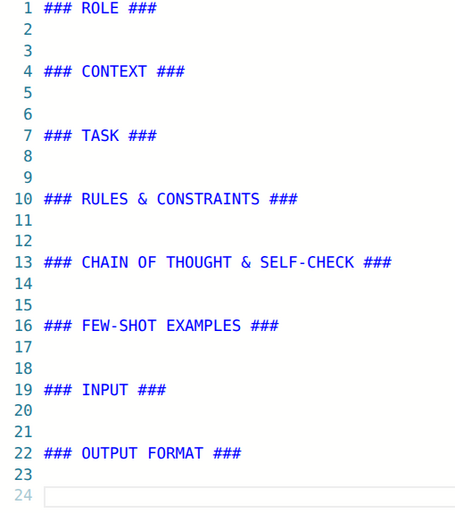
Below is what I consider an ideal baseline prompt structure:
### ROLE ### (role): Don't let the AI guess how it should communicate. Assign it a role (e.g., "You are an expert Python developer" or "You are a creative advertising copywriter"). This automatically adjusts the tone and vocabulary it will use.
### CONTEXT ### (context): The AI cannot read your mind. Explain the "why" and the "for whom" (e.g., "I am preparing an investor presentation for a new mobile app"). This provides the context required to avoid generic answers.
### TASK ### (task): Place your request here in a direct manner. It should be expressed as an action verb (write, summarize, analyze, translate). There is no need to say "please." Doing so only increases token consumption.
### RULES & CONSTRAINTS ### (rules and constraints): This is where you define boundaries for creativity and reduce the risk of hallucinations. Specify exactly which rules must be followed (e.g., "Do not use technical jargon" or "The text must not exceed 200 words").
### CHAIN OF THOUGHT & SELF-CHECK ### (reasoning and self-review): It is often useful to instruct the AI to think step by step and review its answer before delivering it. This reduces logical errors, especially in tasks that require more advanced reasoning.
### FEW-SHOT EXAMPLES ### (examples): The best way to teach is through real input/output examples. This helps the model calibrate the final result.
### INPUT ### (input): The raw data, text to analyze, or specific question.
### OUTPUT FORMAT ### (output format): Do you want a table? JSON? Markdown?
Conclusions
Mastering basic prompting techniques is the prerequisite for scaling any generative AI product. With these best practices as a foundation, we can move on to more advanced architectures such as agents, orchestration frameworks, and recursive optimization techniques.
References

José Luis Palomino
My profile is the result of combining my passion for language (Bachelor’s degree in English Studies) with the world of technology (Master’s in NLP and AI). Currently, as a Prompt Engineer at Paradigma, I design how we communicate with language models. Some of my responsibilities include optimizing latency, managing cost per token, selecting the most suitable model based on context, and rigorously evaluating its behavior to consistently ensure the best results in production.
View more of José Luis.More thoughts about this.
Read more.
The Importance of Prompt Engineering.

NLP pipeline for risk analysis: from unstructured documents to structured JSON.

AI Platforms: From Theory to Practice.

Langfuse vs Langsmith I: Prompt Versioning and Tracing.

Comments are moderated and will only be visible if they add to the discussion in a constructive way. If you disagree with a point, please, be polite.

Tell us what you think.